Welcome to My New fitness Blog
Working Your Way Through Fitness
The world of fitness is abuzz lately about Crossfit. I definitely see the attraction and how their is a certain glamour to watchin gthe televised event of the top 1% of Crossfitters killing the challenges placed in front of them showing off their amazing bodies that they worked so hard to earn. But how did they get there?
I want to talk to you today about general fitness for the remainder of the population, how you can work your way to being healthy, and how you can further push into those top 1% spots and be a true athlete.
I am a personal trainer in the fitness industry currently. I have several certifications and 3 years of experience ranging from helping a gentleman lose 300 lbs over a two year period to helping another gentleman prepare and recover from back to back knee replacements. I have trained multiple women who had done very little exercise in the past who decided they wanted to run a marathon within a year. On the higher end of this, I have trained a division 1 lacrosse athlete. I spent 8 years in a mentor-ship with an athletic trainer who worked with the Baltimore Ravens and who spent several years as a physician at a rehab clinic. With this experience I want to walk you through some of the steps that can be taken to make a real difference in you health and your fitness.
NASM (National Association of Sports Medicine) has a model for fitness progression.
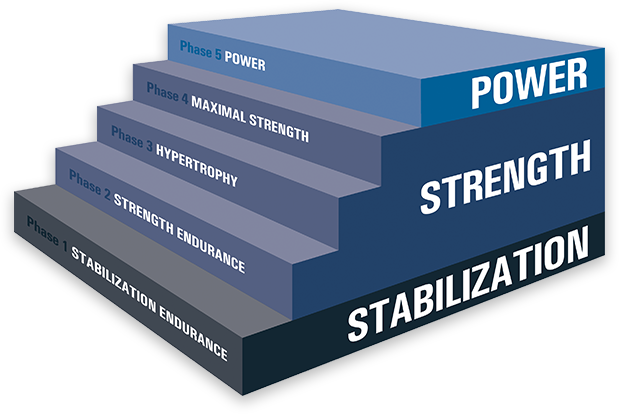
Honestly, this is really basic. However, this is tried and true when it comes to healthy, safe, and steady progression. I use this model myself for a lot of my clients after walking them through some fitness assessments.
Step 1 is Stabilization Endurance. This is building up your muscles ability to function under resistance for extended periods of time in a safe manner. A typical example of this is a plank. You are holding a horizontal position with your toes and forearms placed on the ground stabilizing your body. During this you aren’t contracting any more or less at any given point. This is called, Isometric Contraction. We are using a plank to teach your body how to safely control you shoulders, hips, and core. This leads to being able to properly and safely stabilize you joints during more complex exercises.
Step 2 is Strength Endurance. After you have mastered Stabilization Endurance it’s time to work on increasing the volume of your work. This means higher repetitions and more sets. An example of this is running. If you went out and ran the same distance everyday, would you be able to go out and just run double the distance with no issues? Not likely. your legs would get really tired and you would start to feel like you can’t catch your breath. You would want to steadily increase how far you ran every day. This is what we are talking about when we say Strength Endurance. We want to decrease how quickly our muscles get tired during exercise.
Step 3 is Hypertrophy. Hypertrophy is muscle growth. We want to increase the size of our muscle fibers so that they can be trained later to withstand a great load or resistance. We do this through max loading during higher repetitions of our sets of exercises. We now have moved past just increasing how many repetitions we are doing, now we are doing lots of repetitions with as much weight as we can handle for those repetitions. These sets and repetitions usually range from 20 repetitions to 5 and can range from 3 sets to as many as 20! The time our muscles spend under tension signals to our body that they need more strength. Our body supplies our skeletal muscle with protein from our diet and the fibers grow.
Step 4 Maximal Strength. Maximal Strength is picking up where Hypertrophy leaves off. We are taking those newly enlarged muscle fibers and training them to pull larger loads or greater resistances. We do this through lower repetitions at much higher weights. There is the universal base where most people start at for strength, 5 sets of 5 repetitions. This is a good place to start, but I recommend continuing your research or talking to a Certified Personal Trainer about progressing your strength goals from there.
Step 5 is Power. We’ve finally started getting into Crossfit style strength moves like you’ve seen on TV. Power is intended to increase the speed at which you can move large amounts of weight or resistance. Examples of this are the Olympic style lifts, Squats, Cleans, Snatches, etc. These are mean’t to bring strength into the real world. Power gives strength practical application. These are incredibly rewarding exercises to complete. Power uses complex movements to improve your bodies strength and speed in a holistic complex way. It focuses on many different muscles and joints forcing your muscles to work together. I definitely recommend working with a Personal Trainer or trusted friend who understands fitness to a professional degree as these moves are very dangerous if done improperly.
This should give you a better understanding of how to build up your health and fitness in a safe and proven manner. Follow the steps and when available accept any and all help that you can. You’ll find that the fitness industry is full of people who’d love nothing more than to help you out and make a new friend with a fellow gym goer.
Best In Health
Brett Broering
Follow My Blog
Get new content delivered directly to your inbox.
 Site Title